
The Ultimate Explainer: How Printed Umbrellas Are Made (and What Lasts)
A printed umbrella looks like one object. It is really a stack of decisions: which fabric, which ink, and at what point in the build the design gets applied. Print the canopy before it is cut and sewn and you can print almost anything, edge to edge. Print it after assembly and you are limited to simple shapes in a few colors. That one choice explains most of the price gaps you will see between quotes, and most of the disappointment two summers later when a logo has gone patchy and gray.
Here is how the three main methods work, what each one is good at, and what actually wears out first.
Before the ink: panels, rolls and finished canopies
Most canopies are built from six to ten triangular panels cut from a roll of polyester or nylon, sewn together, then stretched over a rib frame. That means a printer has three possible moments to work: on the flat roll of fabric, on pre-cut panels, or on the sewn canopy itself.
Roll and panel printing give the sharpest results. Printing on a finished canopy — usually with a rotary screen that rolls around the dome — is fast and cheap for simple one-color logos, but registration is looser and the print can distort where the fabric curves over ribs.
If your design has lines that cross seams, ask how the panels are matched. A stripe that runs across six panels can shift a few millimeters at each join. Good factories print a continuous length and cut afterwards, or at least supply a pre-production sample with the seam lines marked so you can check alignment before committing.
Screen printing: the workhorse for logos
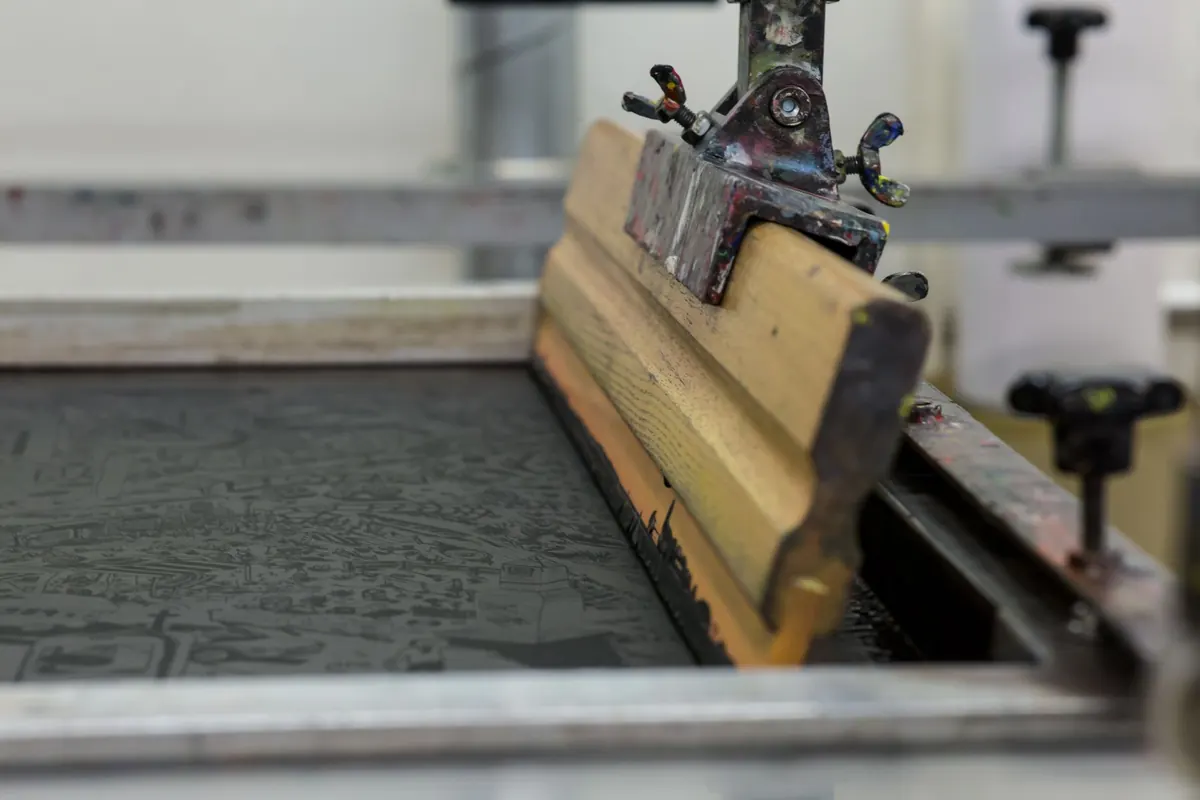
Screen printing pushes thick ink through a fine mesh using a rubber squeegee, then cures it with heat. One screen is needed per color, which is why a three-color logo means three passes and three setup charges.
- Artwork is separated into individual colors, each burned onto its own mesh screen.
- Fabric is laid flat and the screen aligned over it.
- Ink is dragged across the mesh, passing through only the open areas of the design.
- The printed fabric is heat-cured so the ink bonds and stops rubbing off.
The ink sits on top of the fabric in a fairly thick layer, which is why screen printing covers dark canopies well and resists scuffing. The trade-offs are gradients and photographs, which have to be faked with halftone dots that look coarse at umbrella scale. Keep it to one to three solid colors and screen printing is hard to beat.
Digital printing: no screens, no minimums
Digital printing sprays ink directly onto fabric, or onto transfer paper that is then heat-pressed onto the canopy. There are no screens and no setup fee, so a single umbrella costs roughly the same per unit as the tenth. That makes it the sensible route for samples, small promotional runs, one-off gifts and prototypes you want to see in your hand before ordering a thousand.
The catch is volume. Per-unit ink cost stays flat while screen printing gets cheaper as quantities climb, so digital loses its advantage somewhere in the low hundreds depending on the design. Durability is also more variable: a well-finished pigment print on decent polyester holds up fine, but the ink sits on the surface like a thin film and can fade or rub at high-wear points. Always ask which ink and finishing process the printer uses, and get a sample you can scratch and fold.
Dye sublimation: ink that becomes the fabric
Sublimation works differently. The design is printed onto transfer paper, then heat and pressure turn the ink into gas, which bonds into the fibers of a polyester canopy. Nothing sits on the surface. There is no layer to crack, peel or flake off, which is why sublimated prints survive folding and abrasion better than anything else over time.
It also allows full-bleed artwork: a sunset, a photo, a pattern that wraps the whole dome with no color limits. Panels printed as one continuous piece before cutting line up beautifully at the seams.
The restrictions are real, though. The fabric must be polyester, or a poly-coated blend, and it must start light — often white. Sublimation cannot print white ink, so dark canopies cannot be sublimated, and a nylon canopy is out of the question. If your supplier offers sublimation on nylon, ask exactly what the fabric composition is.
Durability: what wears out first
The print is rarely the first thing to fail. These are the usual culprits, in rough order of how often they show up:
- Sun fade. Ultraviolet light dulls ink long before rain damages it. Blacks go gray, reds drift toward orange.
- Crease abrasion. Folding along the same lines every time wears ink and fabric at those exact spots.
- Coating loss. The water-repellent finish on the fabric wears out before the print does, leaving a canopy that still looks fine but soaks through.
- Edge and tip wear. Rib tips and panel edges rub against the print when the umbrella opens and closes.
- Frame failure. A bent rib or snapped runner ends an umbrella's life regardless of how good the print is.
Two habits extend print life more than any ink upgrade: let the canopy dry fully before folding it, and store it loosely rather than crushed into the same creases for months. Leaving a printed umbrella in a hot car is also rough on both coating and ink.
What drives the cost
Quotes vary wildly because the inputs vary. When you compare suppliers, compare these:
- Number of colors or screens — each one adds setup and a pass.
- Quantity — screen printing's setup cost is spread thinner the more you order.
- Print coverage — a full-bleed sublimated dome uses far more ink than a small chest logo.
- Fabric weight and composition — thin 190T fabrics cost less and print less crisply than heavier polyester.
- Proofing and color matching — specifying an exact brand color adds a step, but avoids a mismatch.
- Lead time — rush jobs cost more at every factory.
Choosing a print method that still looks good in year two
Start with the artwork, not the price. A two-color logo on a dark canopy belongs in screen printing. A photograph or a gradient belongs in sublimation, on a light polyester canopy. A run of twenty belongs in digital unless the design is sublimation-friendly and the quantity justifies it.
Then ask your printer four questions: which fabric exactly, which ink and finishing, how the design is aligned across seams, and what the per-unit cost looks like at 50, 250 and 1,000 pieces. A supplier who answers all four without hesitation is usually a supplier whose print survives a second winter.
Finally, order one sample and treat it badly. Fold it, leave it on a windowsill for a fortnight, open and close it a hundred times. That test tells you more about durability than any spec sheet.
Photo: Wendelin Jacober / Pexels